The $30 Million+ Lesson: What Every Homeowner Can Learn from Christ Church’s Air Rights Sale
November 18, 2025
< Back to Blog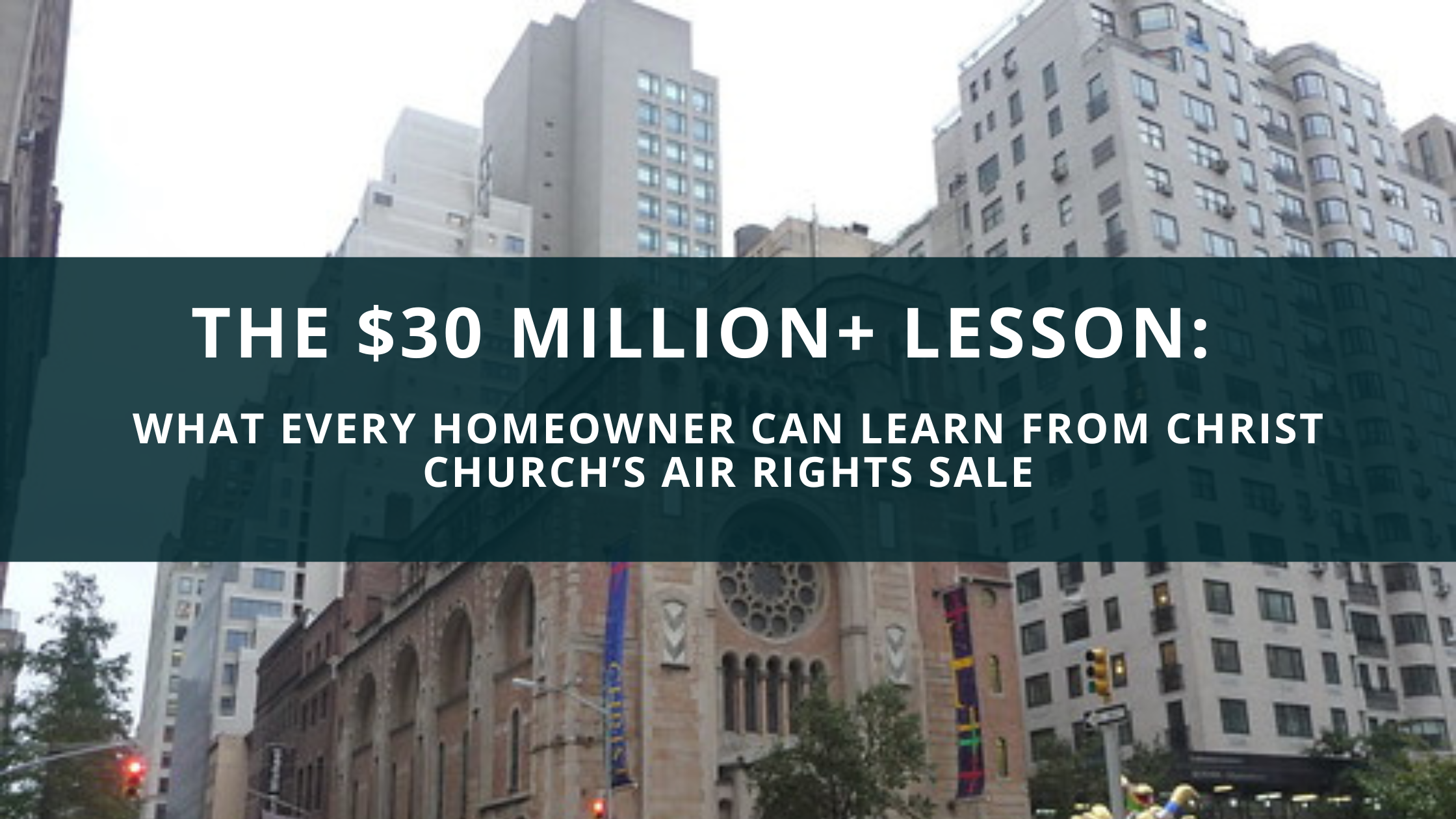
In 2005, Christ Church on Park Avenue in New York City made a surprising financial move, one that didn’t involve donations, fundraisers, or charity events. Instead, the church sold something invisible: the right to build in the empty space above its roof.
The result? A staggering $30 million+ payday.
Developers paid $430 per square foot for the church’s air rights, a record-breaking figure at the time.
While it may sound like a one-off Manhattan miracle, this story carries a powerful lesson for homeowners everywhere: you might be sitting on hidden value you never knew existed.
So What Exactly Did Christ Church Sell?
Every piece of real estate has three dimensions: land, structure, and air.
Air rights (also known as transferable development rights) allow the owner of a property to sell or transfer the unused vertical space above their building to another developer who wants to build higher than local zoning rules normally allow.
In Christ Church’s case, its historic structure couldn’t be expanded upward due to landmark restrictions. But those unused rights didn’t go to waste; they became tradable assets. A developer across the street purchased them to add more floors to a new high-rise project.
The church kept its historic building intact, and earned millions by selling the potential above it.
The Takeaway for Homeowners
You don’t have to own a cathedral in Manhattan to have air rights worth something. If your property has unused development potential, that value can be unlocked, especially in areas where zoning limits building heights.
Here’s what this means for you
- Your roofline has value - The space above your property is a tradable commodity. Just like Christ Church, you might not be using it, but someone else, or even a company, might need it.
- You don’t have to sell your home to profit - Selling air rights doesn’t mean giving up ownership of your property. It’s like leasing part of your vertical space, while keeping your home intact.
- Developers are constantly looking for more height - In dense cities, the ability to build even a few extra floors can be worth millions. That demand fuels the air rights market.
- Technology can make the process accessible - What once required lawyers, surveyors, and developers can now happen digitally, through blockchain-powered marketplaces like SkyTrade, where homeowners can discover, verify, and trade air rights securely.
Why Most Homeowners Don’t Realize This
For decades, air rights trading was a quiet part of real estate, limited to insiders and large developers. The complexity of zoning laws and the lack of public tools meant that average homeowners never knew they had a hidden asset.
But the truth is, every property has an invisible layer of value, and in urban or growing areas, that layer can be significant.
Christ Church’s $30 million windfall isn’t an exception; it’s a preview of what’s possible when vertical space is recognized as part of your real estate portfolio
The Future of Air Rights
As cities expand vertically, unused airspace will only grow in value. Homeowners near developing areas may one day find that their empty air is worth a lot.
The Christ Church sale was ahead of its time, but it won’t be the last of its kind. The future of real estate isn’t just about land ownership; it’s about air space ownership.
SkyTrade’s Connection
At SkyTrade, we’re building a platform that helps homeowners identify, verify, and claim their unused air rights, and a marketplace for them to trade these rights just like Christ Church did, but with just a click, and without the bureaucracy, confusion, or insider barriers.
Because the next $30 million air rights deal doesn’t have to belong to a church or a skyscraper developer, it could belong to you.
How to get started?
Visit our website to learn more
Sign up here to locate and claim your air right.
Join our Discord to connect with other homeowners and developers.
Follow us on X (Formerly Twitter), so you don’t miss out on future updates.


