No live visibility
You find out after complaints.


SkyTrade brings drone detection, security, site permitting, and property monetization into one platform. It helps governments and critical infrastructure owners manage drone activity, coordinate responses, enable legitimate operations, and unlock new commercial opportunities.
Built for municipalities, counties, port authorities, critical infrastructure operators, and property owners.






A drone can cross a school, stadium, or hospital in seconds.
When residents complain, they call City Hall, not the drone company. They call you.
Most municipalities cannot:
You find out after complaints.
When incidents happen, there's no clean record.
Rules vary block by block, creating confusion.
Oversight stays a cost center. Each new flight is a new expense with no offsetting revenue.
Ungoverned airspace is risk.
Governed airspace is infrastructure.
Infrastructure creates value.
The Local Government OS for Low-Altitude Airspace
Atlas connects the municipal product workflows. Organize available site information, applications, and program records, and confirm the supported integrations and data access for your deployment.
Manage municipal property-use applications, conditions, and decision records. Your city defines the applicable authority; a local approval does not replace FAA flight authorization.
Review observations from supported sensors alongside relevant municipal records. Confirm deployment coverage and response ownership; detection does not establish flight legality.
Detection alone is not security. Patrol drones launch on schedule or on alert. Live video verifies threats before ground teams respond.
The development rights above your land are a real estate asset. Inventory them, value them, and convert them into capital through sales, transfers, and development leases.
Our expert guides go beyond overviews - legally grounded analysis written for city attorneys, policy directors, and senior administrators who need defensible answers.
What authority cities actually hold, where federal preemption applies, and how to write ordinances that hold up in court.
FAA Part 107, Part 108 integration, and local enforcement obligations mapped to specific municipal requirements.
Monetization structures, fee authority, and case-law grounding for airspace governance programs that generate real revenue.
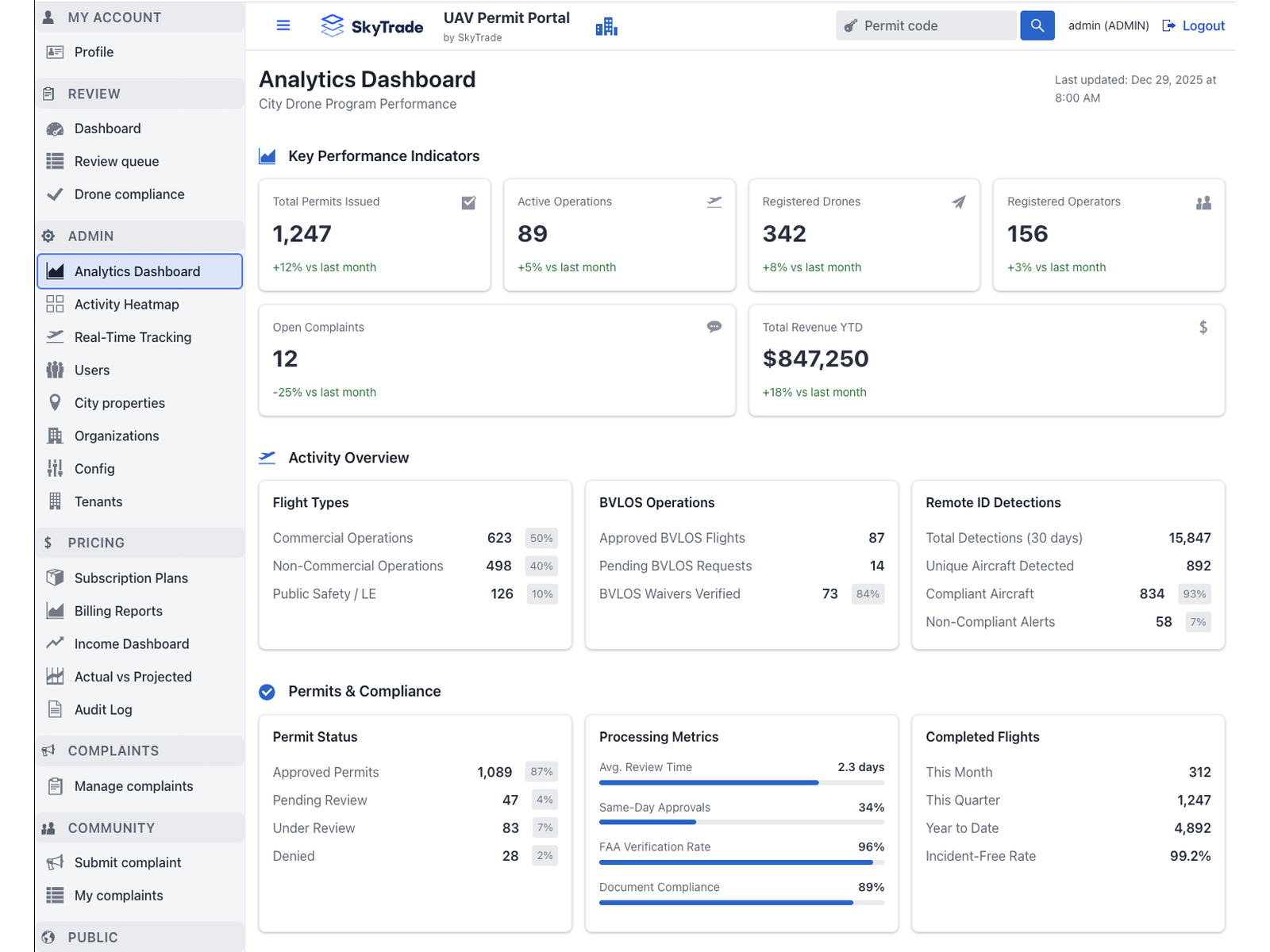
Permits issued, active operations, registered drones and operators, open complaints, and revenue, rolled up for the city manager, drilled down for the program lead.
Request a demo and we'll show how SkyTrade fits your local goals, your departments, and your rules. You'll see the dashboards, geofencing, real-time visibility, audit trails, and the revenue options that help fund safe operations.
Define the security evidence your procurement requires. Ask which reports and controls cover the proposed service, their scope and reporting period, and which records and retention settings would apply.
Answers for procurement, legal, and operations.
No. SkyTrade does not replace FAA authority. The platform supports municipal workflows and records; a local property-use decision does not authorize flight paths or altitudes.
Request a scoped estimate for configuration, equipment, integrations, support, staff time, and maintenance. Assess potential property revenue separately; a deployment is not guaranteed to pay for itself.
Agree the schedule after defining the pilot, equipment, integrations, training, and acceptance criteria. A cloud dashboard alone does not establish operational readiness.
Applications and records are software workflows. Receiving Remote ID broadcasts requires compatible receivers or authorized access to an existing receiver feed. Confirm supported sensors and integrations for the proposed deployment; LAANC authorization is not a live telemetry feed.
Choose a program owner and assign application review, incident coordination, and record responsibilities. Confirm what support SkyTrade would provide and what remains with city staff. Staffing depends on scope and workload.
Define the observations and application records needed for the deployment. Confirm ownership, authorized access, retention, exports, and the security evidence covering the proposed service during procurement.
Discuss the systems, data access, and workflows your city needs to connect. Confirm supported integrations, responsibilities, and acceptance criteria before assuming a connection is available.
Define one municipal site or use case, the observations you need, and acceptance criteria. Evaluate results and costs before expanding. A local program boundary does not create a flight restriction.
Discuss the reporting and incident workflow your deployment supports. Record the complaint, time, available observations, and confirmed facts. Assign response ownership and referral procedures; incomplete reception cannot establish exactly what was flying.
The offering is intended for municipalities, counties, port authorities, critical infrastructure operators, and property owners. Define the use case, staffing, equipment, and procurement needs for your organization rather than assuming one configuration fits every jurisdiction.
Compare the agreed acceptance criteria with observed results, staff workload, costs, and remaining gaps. Confirm the next-stage scope and commercial terms before continuing. Do not assume fee income will cover deployment costs.
Request a demo and identify the audience, proposed use case, and questions to address. A useful briefing separates public-property decisions, federal flight authority, incident responsibilities, and budget assumptions.
A defined program can give residents a clearer complaint process and staff a way to review available observations and site-use records. Assess results against the pilot goals. Safety improvements and property income require evidence rather than a universal promise.
Start with a current municipal task: a public launch site, recurring complaints, incident coordination, or a property opportunity. Establish authority, workload, costs, and acceptance criteria before procuring a program. Drone overflight alone does not create a local revenue entitlement.